
HOW TO CHOOSE THE RIGHT BIBLE FOR YOUR CHILD
(By Age and Reading Level)
You want your child to love God’s Word. But walk into a bookstore or search online, and you’re hit with dozens of options: storybook Bibles, full-text Bibles, different translations. How do you know which one is right for your child right now?
The best Bible for your child depends on their age, reading level, and how they’ll use it. Younger children need storybook Bibles with simple language and pictures. Early readers need translations like the NIrV or ICB. Older kids can graduate to the NLT, NIV, or ESV.
So which translation fits which age? What’s the difference between a storybook Bible and a full-text Bible? And how can you help your child actually engage with Scripture? Here’s a simple guide to choosing the right Bible for your child.
Disclaimer: This post may contain affiliate links.
Storybook Bibles vs. Full translation Bibles
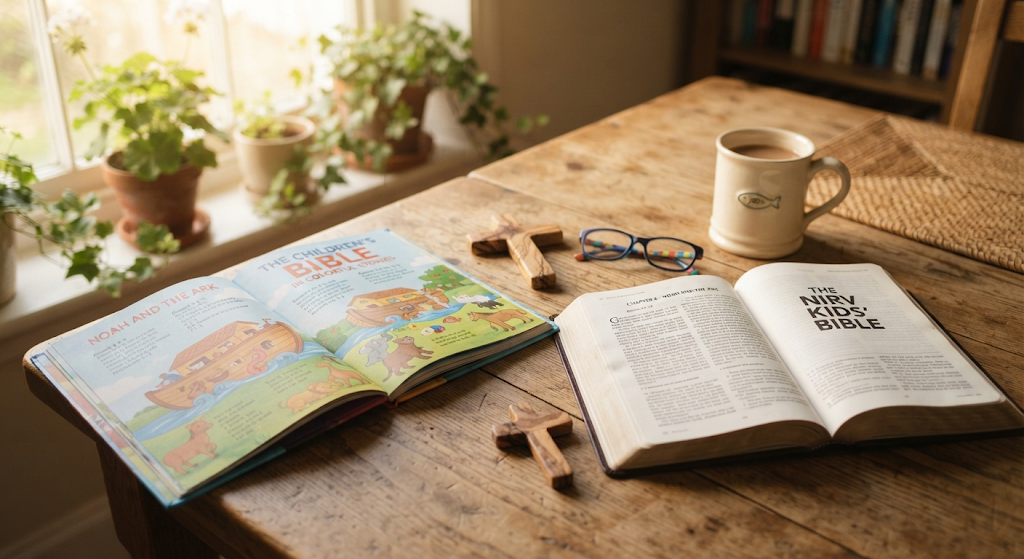
Before you choose a translation, you need to decide what kind of Bible your child needs. There are two main options:
| Type | Best For | What It Is |
|---|---|---|
| Storybook Bible | Ages 0–5 | A retelling of key Bible stories with illustrations. Not a full Bible—it’s an introduction. |
| Full-Text Bible | Ages 6+ | The complete Bible in a translation your child can read. |
When to choose a storybook: If your child is a toddler or preschooler, start here. These Bibles build familiarity with the big stories and themes of Scripture before a child can read .
When to choose a full-text Bible: Once your child is reading on their own (usually around age 6–8), it’s time for a real Bible. They can start navigating Scripture for themselves.
A note: Some storybook Bibles, like The Jesus Storybook Bible, are designed to point every story toward Jesus. That’s a beautiful foundation
Bible Translations by Age and Reading Level
Not every translation is meant for every age. Here’s a simple guide based on reading level and comprehension.
| Translation | Grade Level | Best For | Notes |
|---|---|---|---|
| NIrV (New International Reader’s Version) | 2nd grade | Ages 6–9 (early readers) | Based on the NIV but simplified. Designed as a “stepping stone” to the NIV. |
| ICB (International Children’s Bible) | 3rd grade | Ages 8–10 | Not a simplified adult Bible—translated specifically for children. |
| NLT (New Living Translation) | 6th–7th grade | Ages 11–13 (middle school) | Flowing, modern language. Good for kids ready for a “real” Bible. |
| CSB (Christian Standard Bible) | 7th grade | Ages 12–14 (middle school) | Highly accurate with a balance of literal and dynamic translation. Great for study. |
| NIV (New International Version) | 7th grade | Ages 12+ (teen/adult) | The standard. More literal than NLT but still readable. |
| ESV (English Standard Version) | 9th–10th grade | Ages 14+ (high school+) | More literal, great for deeper study, but less accessible for younger readers. |

Two translations to know for early readers:
- NIrV: The “younger sibling” of the NIV. It keeps the accuracy but simplifies the words and sentence structure. It’s the most widely recommended Bible for early readers. Personally, this is the one I would stick with until they are ready for the NLT.
- ICB: Not a simplified adult Bible—it was translated specifically for children at roughly a 3rd-grade reading level.
For middle schoolers: The NLT and CSB are both excellent choices. The NLT is a bit easier to read. The CSB is a bit more precise. Either works well.
For teens: The NIV and ESV are the standards. If your teen is ready for deeper study, the ESV is a great choice. If they want something more readable, the NIV or CSB works.
Recommended Bibles by Age Group
Here are some of the most trusted Bibles for each age and stage. You don’t need to buy all of them—just find the one that fits your child right now. Click on the Bible to learn more about it.
Storybook Bibles (Ages 1–5)
| Bible | Best For | What Makes It Stand Out |
|---|---|---|
| The Beginner’s Bible | Ages 1–4 | Over 90 simple stories with bright, classic illustrations. A trusted first Bible for decades. |
| The Jesus Storybook Bible | Ages 3–8 | Points every story toward Jesus. Beautiful language and art. |
| The Biggest Story Storybook Bible | Ages 3–6 | Kevin DeYoung’s retelling of the Bible’s big story, with vivid illustrations. |
Early Reader Bibles (Ages 6–10)
| Bible | Best For | What Makes It Stand Out |
|---|---|---|
| NIrV Adventure Bible | Ages 5-8 | Full-color features, memory verses, and fun facts. The bestselling early reader Bible. |
| NIV Adventure Bible | Ages 6-10 | Full-color features, memory verses, and fun facts. The classic children’s Bible. |
| ICB Holy Bible | Ages 7–10 | Written at a 3rd-grade reading level. 300 highlighted memory verses and illustrations. |
| NLT GO Bible | Ages 8–11 | Clear NLT text with graphics explaining the Bible’s big story. |
| NLT Discovery Bible | Ages 8–11 | Interactive features designed to help kids discover Scripture for themselves. |
| ESV Biggest Story Bible | Ages 6–10 | Full ESV text with illustrations from The Biggest Story. Points every story to Jesus. |
| CSB Explorer Bible | Ages 8–12 | Study helps, maps, and facts. Designed for curious kids who want to dig deeper. |
Middle School / Tween Bibles (Ages 11–13)
| Bible | Best For | What Makes It Stand Out |
|---|---|---|
| The Action Bible | Ages 8–12 | Comic-book style with 230 stories. Perfect for kids who love graphic novels. |
Teen Bibles (Ages 13+)
| Bible | Best For | What Makes It Stand Out |
|---|---|---|
| NIV Quest Study Bible for Teens | Ages 13–18 | Strong study notes in a Q&A format. Recommended by pastors for serious study. |
| CSB Essential Teen Study Bible | Ages 13–18 | 146 devotions and a “Redemption Thread” showing how Scripture points to Christ. |
| NLT Student Life Application Bible | High school–college | Life application focus with Filament app access. |
| ESV Teen Study Bible | Ages 13+ | 12,000 study notes and 365 devotions. For theologically-minded teens. |
How to Help Your Child Engage With their Bible

The translation matters. But what matters more is what happens when they open it. When you first give your child the Bible just let them do a picture walkthrough. Let them look at the pages, the picture, the maps, all the fun little extra details. Point out exciting things.
For younger kids:
- Read aloud together.
- Ask simple questions: “What does this tell us about God?”
- Let them see you reading your Bible.
For older kids:
- Give them space to read on their own.
- Ask what they’re learning—not as a quiz, but as a conversation.
- Use a simple method like WONDER to help them process what they read.
For the whole family:
- Choose a Bible translation you can read together.
- Pick a storybook Bible for family devotions if you have mixed ages.
- Let them choose their own Bible when they’re ready—ownership matters.
A note for ministry leaders: If you’re choosing Bibles for a classroom, there are several things to consider. First, consider which translation your pastor uses at the pulpit. It can be a good idea to be consistent with that. You may also want to look at your curriculum. What translation does it use. The Bible Wonderlife Curriculum is designed to be used with any translation you choose. Consider a translation like the NIrV or NLT that works across a wide age range. It makes teaching easier.
A Simple Checklist for Choosing
Before you buy, ask these questions:
| Question | What to Do |
|---|---|
| What’s their reading level? | Ask their teacher or have them read a sample page aloud. |
| How will they use it? | Bedtime stories? Church? Personal study? |
| Do they need study helps? | Maps, introductions, devotionals—some kids thrive with them. |
| Will they carry it? | A smaller, lighter Bible is more likely to be used. |
| Does it feel special? | Let them be part of the choice. |
A note for parents: Don’t rush the transition from storybook Bible to full-text Bible. Let them linger in the stories. The goal isn’t to get them into a “real” Bible as fast as possible—it’s to help them love Scripture and encounter God through His story.

Imagine this. You’re buying a Bible for your 7-year-old. She’s reading chapter books on her own. You walk into the bookstore and see a wall of options.
You remember the guide: at her age, you’re looking for an NIrV or ICB—a full-text Bible she can actually read. You pick up an NIrV Adventure Bible. The language is simple. The features are fun. She flips through it and says, “I like this one.”
You take it home. That night, she reads the story of David and Goliath on her own. She comes to you and says, “God helped David be brave. He can help me when I am scared, too.”
You didn’t have to teach her. She encountered it herself. That’s the goal.
The right Bible at the right time can shape a child’s faith for a lifetime. Start where they are. Let them grow into more.
And if you want a simple method to help them engage with what they read, the WONDER method is built for that.
Keep Reading
- What Is the WONDER Method? A Simple Way to Study the Bible — the six-step method you can use with your kids
- Why Chronological Bible Teaching Changes Everything for Kids — how the story order shapes understanding

Come. Wonder.
Live…In Jesus.
Resources to help you encounter the wonder of who God is through the Bible.