
WHAT IS THE WONDER METHOD?
A SIMPLE WAY TO STUDY THE BIBLE
You want to study the Bible. You’re not alone in that — and you’re not alone in feeling stuck.
According to the American Bible Society’s 2026 State of the Bible report, only 17% of Americans are “Scripture Engaged” — the lowest number since the survey began tracking it. But another 28% are in what researchers call the “Movable Middle” — people who are curious about the Bible, who wish they read it more, but who haven’t found a way to make it stick.
If that sounds like you, the problem isn’t desire. It’s method.
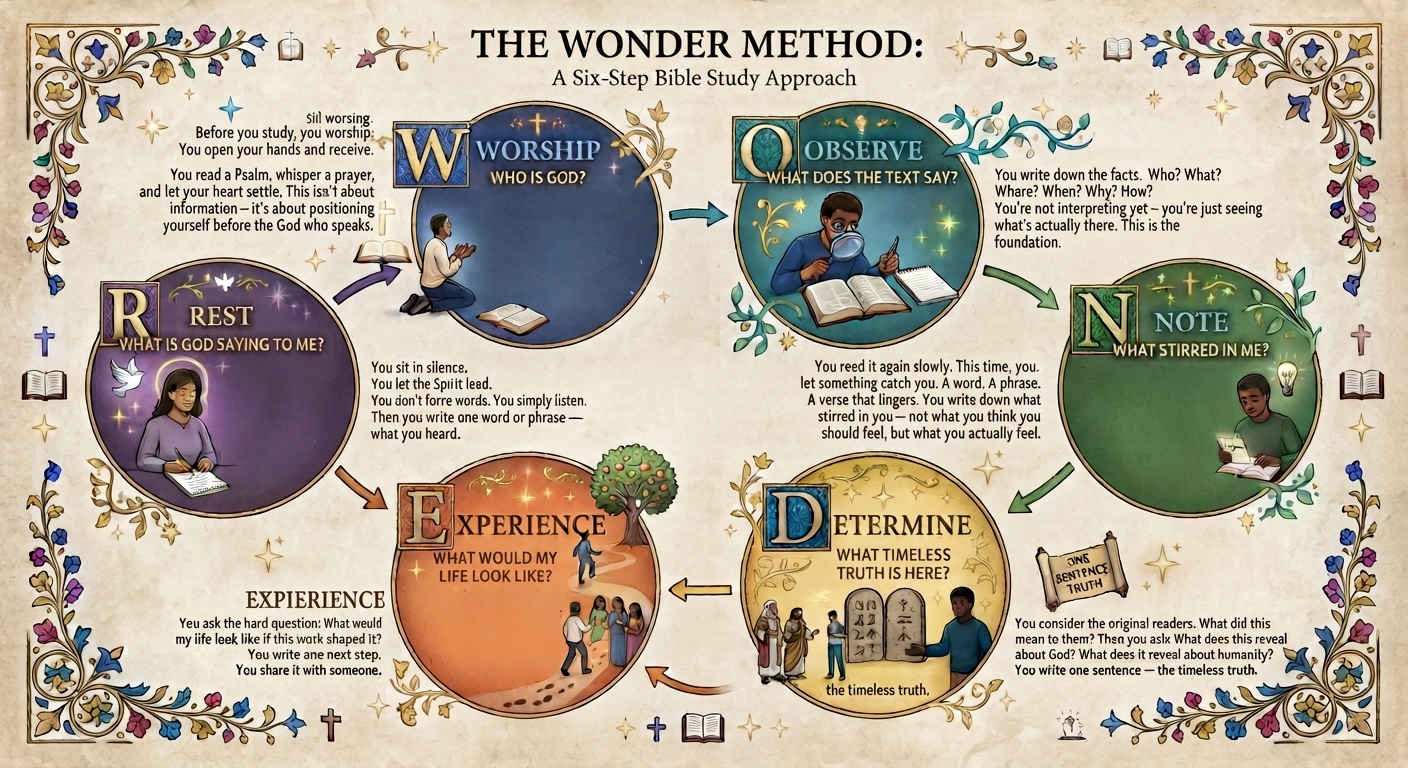
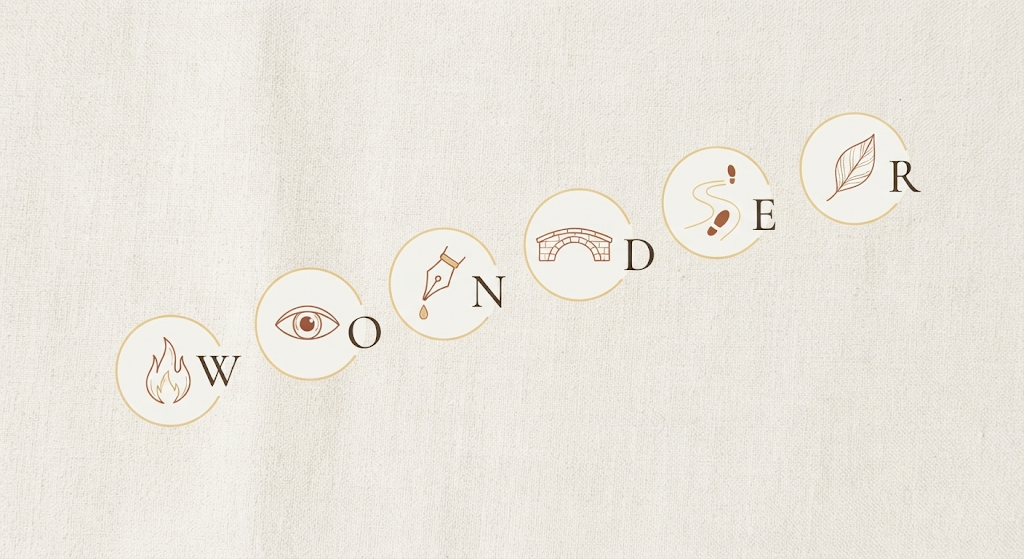
The WONDER method is a six-step approach to Bible study that combines the best of inductive study, SOAP, and Lectio Divina. Each letter stands for a step: Worship, Observe, Note, Determine, Experience, and Rest. It’s simple enough to start today, but deep enough to last a lifetime.
So what does each step look like in practice? And how is it different from the methods you’ve already tried? Here’s how to use the WONDER method and why it might change the way you read Scripture.
What makes WONDER Different?
Most Bible study methods focus on one thing: information or application. They help you understand what the text says or how to apply it, but they don’t always help you encounter God through it. The WONDER method is different. It combines the strengths of three classic approaches:
- Inductive study teaches you to observe the text carefully before interpreting it.
- SOAP (Scripture, Observation, Application, Prayer) gives you a simple, repeatable structure.
- Lectio Divina invites you to slow down and listen for God’s voice.
WONDER brings these together into one method. It’s not about rushing through a passage to check a box. It’s about encountering God in His Word. WONDER leads you to observe the text carefully before interpreting while pausing and inviting you to listen for God throughout a simple repeatable structure.
And the data backs this up. The 2026 State of the Bible report found that people who follow a reading guide, plan, or program are far more likely to actually finish — 74% of those who follow a plan have read most or all of the Bible.
The WONDER method is that plan. Simple enough to start today. Structured enough to keep going.
The rope connection
Before you dive into the W.O.N.D.E.R. steps, place your passage in the big story of the Bible. It’s called The Rope Connection, and it asks one simple question: “Where does this passage fit in the big story?”
You answer by looking at three things that work together like a rope:
- The Strands — Five themes woven through all of Scripture: Identity (Who are we?), Kingdom (Who rules?), Presence (Where is God?), Promise (How does this point to Jesus?), and Wisdom (How do we live?).
- The Covenant Knots — Five promises that hold the story together: Noahic, Abrahamic, Mosaic, Davidic, and New.
- The Milestone Beads — Seven turning points that mark God’s unfolding plan: Creation & Fall, Exodus & God’s Nature, Wilderness, Kingship, Exile, Gospel, and Church & New Creation.

The Rope Connection train you to read every passage through the lens of the whole Bible. Without it, you study a passage in isolation and might miss how it points to Jesus. With it, you see how every passage connects to God’s one big story, and you learn to read Scripture as one story of rescue.
Worship: Starting with God
Before you open the Bible, open your heart.
Worship isn’t just singing songs; it’s recognizing who God is and thanking Him for it. So before you dive into your study, turn your heart toward God. He’s the Author of the Bible and your life. Take a moment to acknowledge who He is, what He’s done, and invite Him to speak to you now.
Here’s why this matters: starting with worship shifts your focus from “what can I get out of this?” to “who is God, and what does He want to say to me?” That shift sets the tone for everything that follows.
“Starting with worship shifts your focus from “what can I get out of this?” to “who is God, and what does He want to say to me?”
Not sure where to start? Pick one:
- Read a Psalm. Psalm 100, 145, or 150 are great places to begin.
- Pray a simple prayer of praise. “God, You are holy and good. You are the one who speaks. Open my eyes to see You, my ears to hear You, and my heart to follow You. Amen.”
- Listen to a worship song. Let the words turn your attention upward before you turn the page.
However you do it, the point is the same: before you hear from God’s Word, position your heart to receive it.
Observe: What Does the Text Say?
“Open my eyes that I may see wonderful things in your law.”
–Psalm 119:18 (NIV)
Observation is about slowing down.
Instead of rushing straight to application, you look carefully at what’s actually in the text. Who’s speaking? Who’s the audience? What words keep repeating? What stands out? This step teaches you to be a detective, not just a reader. And it builds a habit of reading Scripture carefully—which is the foundation for everything else.
So start simple: read the passage. Let God’s Word stand on its own. Just gather facts.
Read it twice. If you have more than one translation, try reading it in two different ones. Read slowly. Let the words settle. Reading aloud is encouraged.
Then ask the 5 W’s and an H:
- Who is speaking? Who is acting? Who is listening?
- What is happening? What’s the main action or conflict?
- Where is this taking place? A city, a temple, a mountain, a desert?
- When is this happening? A Sabbath? A feast? Before or after something?
- Why is this happening? What prompted the event?
- How does it unfold? What’s the sequence of events?
Don’t worry about what it means for your life yet. That comes later. For now, just notice what’s there. The goal isn’t to master the passage; it’s to see it clearly. Because you can’t apply what you haven’t truly seen.
Note: What Stands Out?
After observing, you note what you see.
This can be as simple as writing down a word or phrase that stood out, or journaling what you noticed. The goal isn’t to get the “right” answer—it’s to pay attention. Noting helps you internalize what you’re reading. It moves Scripture from the page into your mind and heart.
So look for one word, phrase, or verse that stands out. This is where the text meets your heart.
Read the passage again. Slowly.
Then ask yourself:
- What word or phrase jumped out at me?
- What surprised me?
- What made me pause?
- What confused me?
- What stirred something in my heart?
Don’t overthink it. If something caught your attention, write it down—even if you’re not sure why yet. That’s often the Holy Spirit nudging you toward something He wants to show you. You’re not trying to solve the passage; you’re learning to listen to it.
Determine: What does it mean?
This is where you ask, “What does this mean?”
It’s the step of interpretation. But it’s not about finding the “correct” answer—it’s about discovering what God is saying through the text. Ask yourself: What does this teach me about God? What does this teach me about people? What is the Holy Spirit highlighting? This step builds discernment and helps you see that Scripture is alive and speaking.
Think of it as the bridge between the ancient world and yours. You’re looking for what the text means for all people at all times—the treasure of the timeless truth.
Start with the Bridge Question: Who were the first readers? What was going on in their world? What would have surprised or challenged them?
Then ask:
- What does this tell me about God? (His love, mercy, power, glory, etc.)
- What does this tell me about humanity? (Our sin, fears, doubts, tendencies)
- If I strip away the cultural details, what eternal truth remains?
Write down the timeless truth. It should be just as true for a Christian in the 1st century as a Christian today.
Here’s the thing: this step takes patience. You won’t always land on something neat and tidy, and that’s okay. The goal isn’t to tie a bow on the passage—it’s to let it speak. Keep asking, keep wrestling, keep listening. Discernment grows in the waiting.
Experience: How does it Apply?
Experience is about living what you’ve learned. Ask yourself: What does this mean for my life today? It could be a prayer, a choice, or an action. This step moves you from knowing about God to actually walking with Him. It’s where transformation happens.
So take the timeless truth you just uncovered and bring it into your everyday life. Step into the wonder of God’s truth and let it transform you.
Start by meditating on this question: “What would my life look like if I truly believed and lived this truth?”
Then ask:
- Where am I living in contradiction to this truth?
- Where am I living in alignment with this truth?
- What is one concrete, measurable action I can take in the next 24 hours to live out this truth?
- Who can I share this truth and/or action step with?
Here’s the thing: this step is where the rubber meets the road. It’s easy to walk away from a quiet time with a head full of insight and a heart untouched. But God didn’t give us His Word just to inform us; He gave it to shape us. So don’t rush past this. Let the truth you’ve found move from your journal into your day. That’s where real change begins.

Rest: Sitting with God’s Word
Rest might be the most counter-cultural step of all.
In a world that rushes, rest invites you to sit with what you’ve learned. It’s not about doing more—it’s about being with God. This step could be a few moments of quiet, a simple prayer, or just reflecting on one thing you learned. Rest helps you understand that Bible study isn’t a task to complete—it’s a relationship to enjoy.
So put down your pen. Close your Bible. Rest. Rest in God’s presence, in His truth, in His abundance. You’re invited to just spend time with Him. Listen.
Sit in silence and let God’s Spirit lead. There’s no time limit here.
If your mind wanders, gently bring it back to the timeless truth. When you sense God’s Spirit has spoken, or when you’re ready, write down anything that comes to mind.
This is the step we’re most tempted to skip and the one we probably need the most. Because if we’re honest, it’s easy to treat time in the Word like a box to check. But God never asked us to complete a task. He asked us to walk with Him. So let this be the moment you stop striving and simply sit in His presence. You don’t have to produce anything here. You just have to be with Him.
How WOnder Compares to other methods
WONDER isn’t a replacement for these methods; it’s a synthesis. It takes the best of each and combines them into one simple, repeatable practice.
| Feature | WONDER | Inductive | SOAP | Lectio Divina |
|---|---|---|---|---|
| Origin | New Synthesis | 19th Century Bible Study Movement | Modern Journaling (Pastor Wayne Cordeiro) | Ancient Monastic Practices (6th Century) |
| Goal | Encounter, Formation, Biblical Theology | Determining what the text means | Daily Application, Journaling | Encounter with God |
| Structure | 6 Steps (W-O-N-D-E-R) | 3 Steps (Observation, Interpretation, Application | 4 Steps (S-O-A-P) | 4 Stages (Read, Meditate, Pray, Contemplate) |
| Time | 20-30 minutes | 30-45 minutes | 15-20 minutes | 15-30 minutes (varies) |
| Analytical Depth | Moderate | High | Low/Moderate | Low |
| Devotional Depth | High | Low/Moderate | Moderate | High |
| Contemplative Element | Yes (R-Rest) | X | X | Yes (Contemplatio) |
| Worship Element | Yes (W-Worship) | X | X | Yes (Prayer) |
| Journaling Focus | Yes (Built in Prompts) | Yes (Notes) | Yes (Built In) | No (Optional) |
| Canonical Context | Yes (Rope Connection) | X (Optional) | X | X |
| Christ-Centered Focus | Yes (Promise Strand) | X (Not Always) | X (Not Always) | X (Not Always) |
| Beginner-Friendly | Yes | X | Yes | X |
| Best For | Those wanting structure, depth, and big picture context | Serious students wanting to dig deep | Busy people wanting a simple daily rhythm | Contemplatives wanting silence and listening |
| Unique Contributions | Rope Connection (Biblical Theology Framework) | Rigorous Observation | Simplicity & Accessibility | Silence & Contemplation |
How to start using WOnder today?
Imagine this. It’s Tuesday morning. You’ve got twenty minutes before the kids wake up. You sit down with your Bible and a cup of coffee…the same Bible you’ve been meaning to read more.
You open to Psalm 100. Before you read, you pause. You thank God for who He is. “You are good. You are faithful. You are here.” That’s Worship.
You read the Psalm slowly. Twice. You notice the word “joy” appears more than once. You notice the command to “enter his gates with thanksgiving.” That’s Observe.
You write down one phrase that stands out: “For the Lord is good and his love endures forever.” That’s Note.
You ask yourself, “What does this tell me about God?” He’s good. His love doesn’t run out. That’s Determine.
You ask, “Where do I need to trust that today?” You think of a conversation you’ve been dreading. You decide to walk into it with gratitude instead of anxiety. That’s Experience.
Then you close your Bible. You sit in silence for two minutes. You don’t ask for anything. You just sit with God. That’s Rest.
Twenty minutes. One Psalm. One encounter.
That’s the WONDER method. And it might be the first time Bible study has felt less like a task and more like a conversation.
You don’t need special training to use the WONDER method. You just need to walk through the steps with an open Bible and an open heart.
- Pick a short passage. Start with a few verses—maybe a Psalm or a Gospel story.
- Worship. Thank God for who He is.
- Observe. Read the passage slowly. What do you notice?
- Note. Write down what stands out.
- Determine. Ask what it means.
- Experience. Ask how it applies.
- Rest. Sit quietly with God.
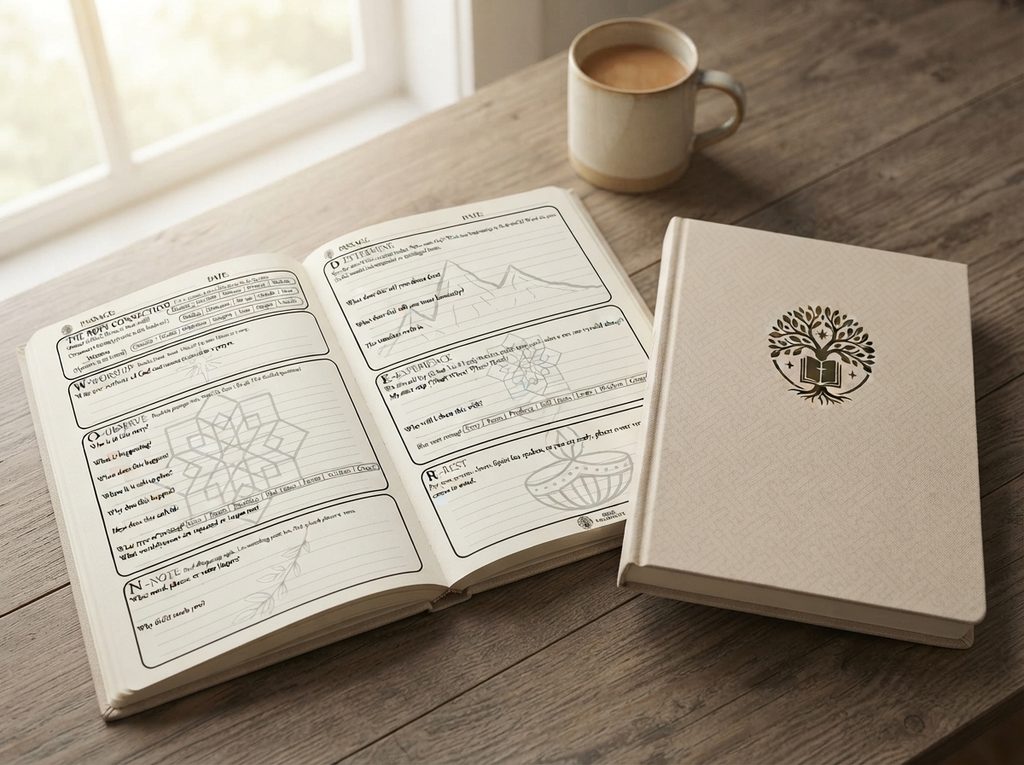
The WONDER method is built into the Bible Wonderlife Journal, which guides you through each step with space to write and reflect. But you can use it anywhere with just a Bible and a notebook.
Want to go deeper? The Bible Wonderlife Journal walks you through the WONDER method step by step—with space to write, reflect, and encounter God through Scripture.
Keep Reading
- What Is the Biblical Rope? Five Strands That Hold the Whole Story Together — the framework that helps you see where your passage fits in God’s story
- Why Chronological Bible Teaching Works — how the WONDER method and the Rope shape the curriculum
- The 5E Lesson Structure for Kids — the teaching framework behind every lesson
Come. Wonder.
Live…In Jesus.
Resources to help you encounter the wonder of who God is through the Bible.