
When I first decided to sit down and study the Bible on my own, I made a classic beginner’s mistake: I started with a challenging book–Isaiah. It was dense, confusing, and it quickly led to frustration. If you’re feeling overwhelmed trying to decide where to begin, you are not alone.
Every Christian friend you ask will likely recommend a different book. . . Matthew, John, or even Genesis. The problem is that many of these suggestions come with hidden context that a new believer or beginner simply doesn’t have.
The single best book of the Bible to start with is Luke. As a Gospel, it provides the most comprehensive benefit because it tells the culmination of the biblical story (Jesus), while including enough detail to understand the context behind the larger story of the Bible.
Why Luke is the Best Choice for You
- Written to Gentiles: Luke wrote specifically to non-Jewish people, which includes most modern readers. He takes the time to explain Jewish customs and words that Matthew or John assume the reader already knows.
- Highly Detailed: Luke gathered and ensured highly detailed, accurate information about the events, making it easy to follow and trust.
- The Context is Built-In: Luke’s Gospel provides enough background knowledge (like Mary and Zechariah’s songs) to understand the significance of Jesus’ arrival without requiring you to read the entire Old Testament first.
This guide will walk you through why we study the Bible, detail the pros and cons of the other popular starting places, and help you choose the easiest translation to ensure your first experience in studying the Bible on your own is engaging and meaningful.
The Foundational Why: Purpose of Study
Before diving into where to start reading, it’s essential to understand why we commit time to God’s Word in the first place. This understanding will provide the motivation you need to stay consistent.
God Reveals Himself to Us
The primary reason to study the Bible is that it is how God chooses to reveal Himself to humanity. Scholars often categorize this revelation into two types:
- General Revelation: Things about God’s character and nature that we can see through creation, such as His power and omnipotence. As Psalm 19:1 says, “The heavens declare the glory of God; the skies proclaim the work of his hands”.
- Special Revelation: God has taken time in history to speak to us directly through His Word and, ultimately, through His Son, Jesus. The Scriptures are the recorded words and stories of the prophets and Jesus’ followers.
By studying the Bible, you are encountering God as He has chosen to speak to us.
We Grow in Faith & Love
The Bible is the most effective tool God uses to guide us and teach us to become more and more like Christ.
Growing Closer: Because the Bible is how God reveals Himself, we can grow closer to God when we spend time with Him in His word.
Encouragement: Our faith grows when we see the examples of those who have gone before us—historical people whose relationship with God is on display. We see how they persevered and grew closer to God, which serves as a great encouragement to us.
Guidance and Training: The Bible is profitable for teaching and training in doing right. Its wisdom helps us become the best version of ourselves, the person God created us to be.
Deep Dive: Your Top Recommendation (Luke)
While there are many places to start reading the Bible, we believe the single most beneficial book for a beginner is the Gospel of Luke. Many experienced Christians recommend Matthew or John, but Luke offers unique benefits for today’s reader.
Why Luke is the Best Choice for Beginners
| Unique Benefit | Explanation |
|---|---|
| Written for Gentiles | Luke was specifically written to a non-Jewish audience. This is crucial because Luke takes the time to explain Jewish customs and terminology that other Gospel authors, like Matthew, assume the reader already knows. |
| Highly Detailed & Accurate | Luke’s account is very detailed, having taken the time to gather and ensure highly accurate information about the events. This chronological approach makes the story of Jesus easy to follow. |
| Built-in Context | Luke provides enough detail to understand the significance of Jesus’ arrival without requiring you to read numerous Old Testament books first. Mary and Zechariah’s songs in Luke 1, for example, describe God’s character, His promises, and the importance of Jesus’ birth, providing necessary background knowledge. |
| Sets Up the Future | Luke is also the author of the Book of Acts. Reading Luke and then immediately moving to Acts (the sequel) provides a great foundation for understanding how the rest of the New Testament books and the early church developed. |
| Focuses on Commitment | Luke focuses on the need and cost of choosing to follow Jesus, without leaving out the benefit that comes with following Him. This makes the book highly practical for a new believer. |
If you are looking for one book to start your journey that provides a great overview of Jesus’s life, a smooth transition into the rest of the New Testament, and the necessary context, Luke is the perfect choice.
Popular Options: Pros and Cons
While Luke is our top recommendation for its balanced approach, many Christians begin with other books. It’s helpful to understand the pros and cons of these popular starting places so you can make an informed choice based on your goals and background knowledge.
Matthew (The King’s Account)
Matthew is the first book in the New Testament and provides a great overview of Jesus’ life and teachings, including the famous Sermon on the Mount.
| Pros | Cons |
|---|---|
| Comprehensive: Covers the entire life of Jesus from birth to resurrection, providing a foundational introduction. | Jewish Audience: Matthew was written primarily to a Jewish audience. It assumes the reader has background knowledge of Old Testament prophecies and Jewish customs, which can make it harder for a non-Jewish beginner to grasp. |
| Chronological: The book generally follows a clear chronological order of Jesus’ life, making it easy to follow along. | Lack of Perspective: It is only one of four gospels, and Matthew presents Jesus specifically as the promised King of the Jews. |
John (The Theological Account)
The Gospel of John takes a different approach than Matthew, Mark, and Luke (the Synoptic Gospels). John is hyper-focused on the person and teachings of Jesus, writing to the whole world to testify that Jesus is our Savior.
| Pros | Cons |
|---|---|
| Hyper Focus on Jesus: Clear, simple metaphors (e.g., “I am the good shepherd”) make it easy to understand complex theological topics like Jesus’ divinity and the nature of God. | Lack of Historical Context: John is so focused on theological themes and ideas that he is less concerned with historical details, which can make it harder to grasp the cultural setting. |
| Spiritual Growth: Many people find that John’s exploration of concepts like “abiding with Christ” provides excellent guidance for living a fulfilling, spiritual life. | Challenging Concepts: John addresses heavy theological concepts and deep Jewish symbolism that can be more difficult for a brand-new believer to fully comprehend. |
Genesis (The Foundational Account)
Genesis is the first book in the Bible and is the book of beginnings (life, marriage, nations, sin). Many recommend starting here to understand the overall narrative and why the world needs Jesus in the first place.
| Pros | Cons |
|---|---|
| Foundation of the Narrative: Genesis provides the essential framework for the rest of the Bible. It is where we are introduced to sinfulness and God’s promise of a solution. | Complex Themes: Contains complex themes and stories (like the sin of Adam and Eve affecting us all) that can be challenging to interpret immediately. |
| Rich in Stories: Full of familiar and relatable stories like Adam and Eve, Noah’s Ark, and Joseph. | Ancient Cultural Context: As a very old book, its cultural context is completely different from the modern world. It can be difficult to relate to ancient customs and practices without study aids like commentaries. |
The Best Translation for Beginners
Now that you’ve determined where to start reading, the next critical question is: What Bible translation should I use?
Choosing an accessible translation will make the biggest difference in your reading comprehension. You want to avoid complex, antiquated language that makes the simple act of reading feel like a struggle.
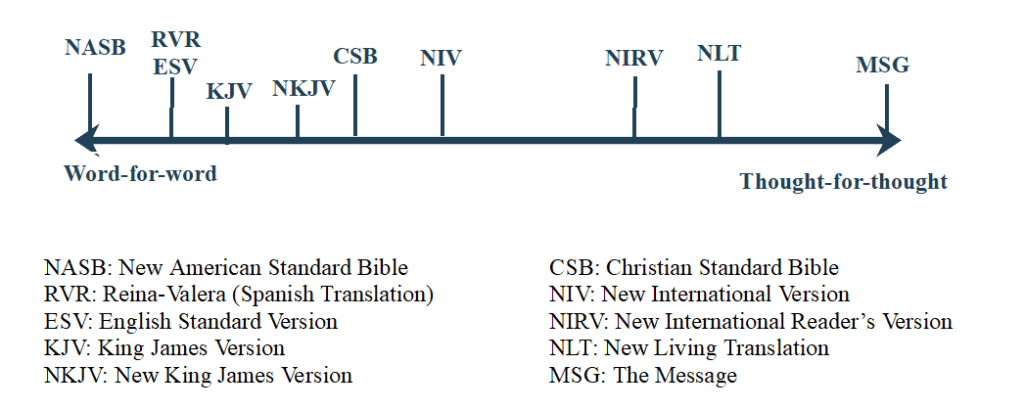
Understanding Translation Categories
Bible translations are categorized based on their approach to translating the original Hebrew and Greek into modern languages.
| Category | Description | Focus (Translation Style) |
|---|---|---|
| Formal Equivalence | A more word-for-word translation style, attempting to be as close to the original structure as possible. | Accuracy (Often at the expense of readability) |
| Functional/Dynamic Equivalence | A more thought-for-thought translation style, focusing on conveying the original meaning in modern, natural language. | Readability (Often used for daily reading) |
| Paraphrase | Uses highly contemporary language; focused entirely on thought-for-thought. | Clarity (Excellent for initial understanding) |
Top Translations & Reading Levels
While translations are not broken into grade-level categories like textbooks, you can gauge their general reading difficulty:
| New International Version (NIV) | Dynamic/Formal | 7+ grade level |
| English Standard Version (ESV) | Formal | 10+ grade level |
| New Living Translation (NLT) | Dynamic | 6+ grade level |
| King James Version (KJV) | Formal | 12+ grade level |
Our Recommendation
For a beginner, the New Living Translation (NLT) is the best, easiest Bible to read and understand. It’s written at a sixth-grade reading level and takes a thought-for-thought approach.
Fun Fact: The NLT was actually made to be read out loud. Reading it aloud can help with reading comprehension and make your study time more meaningful.
The Easiest Way to Start Studying
Now you have your book (like Luke) and your translation (like the NLT). What do you do when you open the Bible?
An easy, effective method to use when starting to study the Bible for the first time is the SOAP Bible Study Method. It provides a simple framework that automatically incorporates the four steps of individual study (Observation, Analysis, Interpretation, Application).
The Simple SOAP Method for Beginners
The SOAP Method is an acronym that guides your study time:
| Step | Action | Practical Instruction |
|---|---|---|
| Scripture | Read and Select | When reading through your passage or chapter, simply choose one verse that stands out to you. Write it down completely. |
| Observation | Analyze What It Says | Make observations about the verse and its context. Ask: Who is writing? Who are they writing to? What words or ideas are repeated? What does this passage say about God? |
| Application | Make It Specific | Take the overall meaning you’ve discovered and apply it to your life. Your applications should be specific and achievable. Is there a sin you need to confess, or a promise you need to remember? |
| Prayer | Talk to God | Conclude your Bible study time in prayer. Talk to God and thank Him for His word, and ask for His help in applying what He’s taught you. |
Your Next Step: Go Deeper
This is a great starting place to ensure your time is meaningful. If you want a more in-depth look at the SOAP method and see a complete example of how it’s used, along with free worksheets: SOAP Bible Study Made Simple Complete Guide and Worksheets.
Conclusion & Next Steps
At the end of the day, it doesn’t ultimately matter where you start reading the Bible, as long as you start. The goal of Bible study is to grow closer to God. So, starting where you are comfortable and engaged is the most important rule.
Reading Roadmap
If you decide to follow Luke and Acts, you may be wondering what order to read the rest of the New Testament. This suggested order is designed to help you build a foundation, reinforce that foundation, and then apply those truths to life.
- Foundation: Luke, Acts
- Reinforcement: Matthew, Mark, John
- Core Doctrine & Application: Romans, 1 Corinthians, Galatians, Ephesians, 2 Corinthians, Philippians, Colossians, James
- Pastoral & Future Look: Philemon, 1 Peter, 2 Peter, Hebrews, 1 Timothy, 2 Timothy, 2 John, Jude, 3 John, Titus, 1 Thessalonians, 2 Thessalonians, Revelation, 1 John
Recommended Old Testament Reading Order:
This sequence is designed for maximum spiritual engagement and breaks up the most difficult books with highly personal and encouraging poetry and wisdom books.
- The Beginning, Law, and Early Wisdom: Genesis, Exodus, Numbers, Job, Psalms, Deuteronomy
- Conquest, The First Kings, and Practical Life: Joshua, Judges, Ruth, 1 Samuel, 2 Samuel, Proverbs
- The Kingdom’s Division, Prophetic Warnings, and Reflection: 1 Kings, 2 Kings, Nahum, Ecclesiastes, Jeremiah, Lamentations, Song of Solomon
- The Law’s Details and The Minor Prophets: Leviticus, Amos, Micah, Obadiah, Jonah, Isaiah
- Prophecy: Focusing on Warning and Destruction: Hosea, Joel, Habakuk, Zephaniah, Ezekiel
- The Exile and Return: Daniel, Esther, Ezra, Nehemiah, 1 Chronicles, 2 Chronicles, Haggai, Zechariah, Malachi
Final Action Step
You have the book, the translation, and the method (SOAP). Now it’s time to build a consistent habit around these tools.
Need a Routine to Go With Your Book?
Knowing where to read is just half the battle; knowing when and how to fit it into your day is the other half. If you need help building a lasting routine check out the Build A Bible Study Habit Guide.
Building a Bible Study Routine Guide
Want to build a Bible study habit? Sign up for our monthly newsletter and we will send you our free Building a Bible Study Routine Guide. You’ll discover your ideal Bible study method and create a customized schedule. Plus, much more.
Here is what you can expect as a Bible Wonderlife subscriber:
-Welcome email with your Free Guide right now!
-Monthly emails with a brief devotional.
-Practical tips and helpful information for growing in your faith.