
Does studying the Bible feel difficult, like a massive, daunting task?
You look at lists of required resources—dictionaries, concordances, handbooks, commentaries—and feel so overwhelmed that you end up scrolling through your phone because it’s simply easier. Yeah, I’ve been there too.
The truth is, all those books are wonderful tools, but they create a huge barrier to entry. You start thinking you need a seminary library just to read a chapter, and that paralyzes you before you even begin.
The Solution: The Minimalist Checklist
The goal of individual Bible study isn’t to become a scholar; it’s to encounter God through His Word. You don’t need a huge budget or an overflowing bookshelf to do that.
To start studying the Bible effectively today, you only need three essential items. This is your personal permission to ditch the complicated resource list and focus on what truly matters.
The 3 Absolute Essentials You Need to Start Today:
- A Bible (The Word): Your primary source of truth.
- A Pen and Journal (The Application): Your tool for processing and committing to change.
- Prayer (The Foundation): Your direct line to the Holy Spirit.
This guide will break down these three essentials, explain why you don’t need everything else, and give you the confidence to open your Bible right now.
The Absolute Essentials (The 3 Must-Haves)
To remove all excuses and start your personal encounter with God today, you only need three things. These essentials cover the Source, the Processing Tool, and the Spiritual Connection.
Essential 1: The Bible
The Word of God is the source and the ultimate authority. Without it, you are not studying the Bible. Don’t worry about having the perfect edition or the most expensive leather binding.
- The Focus: Choose a translation that you can easily read and understand. For most beginners, a dynamic equivalent translation like the New Living Translation (NLT) or the New International Version (NIV) is best, as the language flows naturally.
- The Investment: If you are ready for a slight upgrade, invest in a Study Bible. This functions as a one-stop-shop, putting study notes, simple commentary, and definitions right on the page beside the text. It eliminates the immediate need for external dictionaries and handbooks.
Essential 2: A Pen & Journal
Your Bible study time should not just be passive reading; it must be active engagement. A pen and journal (or any notebook) turn reading into analysis and reflection.
- Why It’s Essential: The act of writing down a verse, a question, or a thought forces your brain to engage with the material and slow down your reading speed.
- The Application Bridge: This is the tool that bridges the gap between what the text says and how it changes you. Writing down your intended application makes your commitment specific and trackable.
- The Minimalist Approach: If you prefer to write directly in your Bible, use a journaling Bible which has wide margins for notes. Otherwise, any notebook you have handy works perfectly.
Essential 3: Prayer
Prayer is the most crucial, non-physical tool you need. Bible study is a spiritual discipline, and we rely on the Holy Spirit to guide us into understanding God’s Word.
- Before You Read: Start your time in prayer. Ask the Holy Spirit to clear your mind, remove distractions, and grant you wisdom to understand the passage.
- During Your Study: If you encounter something confusing or convicting, pause and pray. Ask God directly for clarification and help. He wrote the book!
- After You Finish: Conclude your time by praying over your notes and applications, asking God for the strength to live out the truth you just learned.
Deep Dive: Essential 1-The Bible
The Bible is the only book you must have. But how do you make the best choice without getting overwhelmed by the hundreds of options?
The goal is clarity and context. We recommend a two-part solution: the best translation for readability and the best format for study.
The Easiest Translation to Read
You don’t need to struggle through 17th-century English. The easiest Bible to read is the one that uses modern, natural language.
- Top Pick: Look for a dynamic translation like the New Living Translation (NLT) or the New International Version (NIV). These translations prioritize conveying the original meaning (thought-for-thought) rather than a rigid word-for-word structure. This drastically lowers the reading difficulty. The Christian Standard Bible (CSB) is a good balance between thought-for-thought and word-for-word.
- Avoid: For now, avoid translations like the King James Version (KJV) or New American Standard Bible (NASB). They are excellent, highly accurate translations, but their complex language or literal structure can slow down a beginner and lead to frustration.
The Secret Weapon: The Study Bible
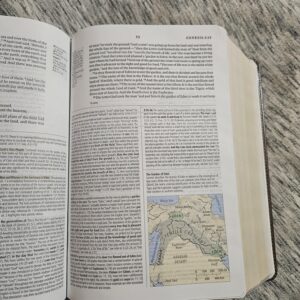
This is where your minimalist approach gets a massive advantage. If you were forced to choose only one book besides a standard Bible, it should be a Study Bible.
A Study Bible is a one-stop tool that replaces the need for: a dictionary, a handbook, and a basic commentary.
| How A Study Bible Replaces Other Tools | What it Provides on the Same Page |
|---|---|
| Replaces the Bible Dictionary | Explanatory footnotes defining key people, places, and cultural concepts. |
| Replaces the Bible Handbook | Comprehensive introductory articles on the author, audience, and main themes of each book. |
| Replaces the Bible Atlas | Maps, charts, and timelines are included right within the text where they are relevant. |
| Replaces Basic Commentary | Concise commentary notes (in the margins) explaining the meaning of passages. |
| Replaces the Concordance | Usually includes a basic word index or reference section in the back for finding key verses. |
Bottom Line: A Study Bible removes the friction of stopping to look up a word or concept in an external book. It keeps your focus on the text and prevents the feeling of being overwhelmed.
Deep Dive: Essential 2-A Pen & Journal
Your Bible is the Source, but a Notebook and Pen are the Processing Tool. This combination is non-negotiable because it forces you to shift from passive reading (which can lead to wandering thoughts) to active study.
The Act of Engagement
Writing is a powerful tool for memory and comprehension. Here is why the pen and notebook are absolute essentials:
- Forces Engagement: When you write down a verse, a key observation, or a question, you are slowing down and forcing your mind to truly engage with what the Bible says. This stops you from mindlessly scrolling through chapters.
- Aids Analysis: The notebook becomes the space where you ask the foundational questions of study: Who wrote this? What is the main idea? What does this say about God?
- Memory and Review: Your notebook becomes a personal spiritual history. You can look back months later and see exactly what God was teaching you, reinforcing previous lessons and strengthening your faith.

The Application Bridge
The notebook is the crucial bridge between Interpretation and Application—the final, most important step of Bible study.
It is where you write down The ONE Thing you will change, pray about, or do differently based on the passage you just read. If you don’t write it down, it’s rarely done.
Ready to Start Studying?
Your notebook is the perfect place to start implementing the SOAP Bible Study Method (Scripture, Observation, Application, Prayer). It provides a simple structure that you can replicate daily.
Remember: You don’t need a fancy leather-bound journal. Any lined paper, a notepad, or even the Notes app on your phone works. The key is to write it down!
Deep Dive: Essential 3-Prayer
While the Bible and the notebook are your physical tools, Prayer is your foundational spiritual tool. Without it, Bible study can quickly turn into a dry academic exercise. Prayer ensures your study transforms into an encounter with God.
Inviting a Personal Covenant Counselor
The Bible is a spiritual book, and the only way to truly understand spiritual truth is through the guidance of the Holy Spirit.
- Your Personal Covenant Counselor: The Holy Spirit is your Personal Covenant Counselor. He is your fierce advocate in the courts of heaven and your gentle guide who heals your heart and helps you in life. You should treat Him as such.
- Actionable Step: Always begin your time in prayer. Ask God to clear your mind, remove distractions, and grant you “eyes to see” and “ears to hear” what He intends for you in that passage. Without this invitation, we risk reading the text through the limited lens of our own biases and assumptions.
The Context of Relationship
The ultimate goal of Bible study is not accumulating information, but deepening your relationship with God.
- Transforming Conviction: If you read a passage that brings conviction, prayer is the action that transforms that conviction into repentance and change.
- Expressing Gratitude: If you read a passage that reveals God’s faithfulness or character, prayer is the vehicle for expressing gratitude and praise.
Closing the Loop
Prayer is the mechanism that ensures the study moves from the head to the heart. It provides the final closure to your time:
- Pray Over Your Application: Review the “ONE thing” you wrote down in your notebook (from Essential #2) and ask God for the strength and discipline to actually live it out in the coming day or week.
- Commitment: Conclude by committing your life and your study time back to God.
The Barrier Remover: What You Don’t Need
We have established the three non-negotiables: Bible, Notebook, and Prayer. Now it’s time to address the elephant in the room: the extensive library of tools that often stops beginners before they start.
Here is the simple truth: you do not need to buy most of the common Bible study resources to have a profound encounter with God’s Word.
Why You Can Ditch the Expensive Shelf
| Tools Commonly Recommended | Why You Can Skip It (For Now) |
|---|---|
| Bible Dictionary / Handbook | These are largely covered by a good Study Bible (Essential #1). You already have definitions and context in the footnotes. |
| Commentaries | Commentaries are someone else’s opinion. Your goal is to encounter the text first on your own. Let the Holy Spirit guide your initial understanding, then use commentaries later to check your work. |
| Concordances / Expository Dictionaries | These are used to look up every instance or original Greek/Hebrew meaning of a word. You can do this instantly and for free using online tools like Bible Gateway or Bible Hub. |
| Atlases & Maps | Like concordances, digital Bible apps and websites often include interactive maps and geographical notes at the click of a button, making a physical atlas redundant for a beginner. |
| Topical Bible | These are useful for topical study, but for a beginner focused on reading through a specific book (like Luke), they are a distraction from the main flow of the text. |
The Core Principle
These tools are not bad; they are just extra supplements. They are nice-to-have resources for deeper research, but they are absolutely not necessary for foundational, life-changing Bible study.
Your focus should be on engaging with the text, not accumulating resources. Use your three essentials, and if you get stuck, look up a quick definition online, then get right back to the text.
Customizing Your Checklist by Study Method
Your three absolute essentials (Bible, Notebook, and Prayer) are perfect for starting any study. However, once you choose a consistent method, you might find that adding one or two specific tools can boost your results in specific areas.
Here is how your minimalist checklist slightly adjusts based on the three popular methods we teach:
| Bible Study Method | Primary Focus | Tools Needed (Beyond the Essential 3) |
|---|---|---|
| Lectio Divina | Meditative, Prayer Focused | 0 Extra Tools. This method relies entirely on the Holy Spirit and personal reflection. Minimalist’s Dream. |
| SOAP Bible Study | Focuses on Observation & Application | Maybe a Bible Dictionary. A dictionary helps you look up people, places, and customs, which greatly enhances the Observation step. |
| Inductive Bible Study | Thorough Observation, Interpretation, & Application | Maybe a Commentary. Inductive study goes deeper into context, and a commentary is useful for checking your Interpretation against scholarly views. |
The Rule of the Minimalist
Do not buy a new tool until you have tried one of these methods for at least two weeks using only your three essentials. Only add a tool when you identify a specific, ongoing frustration that the tool is designed to solve.
Next Steps: Start Now, Not Later
The feeling of being overwhelmed stops more people from studying the Bible than lack of desire ever does. We hope this minimalist checklist has removed the barrier and given you the confidence to start your encounter with God today.
Remember the three absolute essentials are all you need: the Word, a Journal, and the guidance of the Holy Spirit.
Your Final Minimalist Checklist
To keep your study time simple and focused, here is your final action plan:
You now have your three tools. The only thing left is to establish a habit.
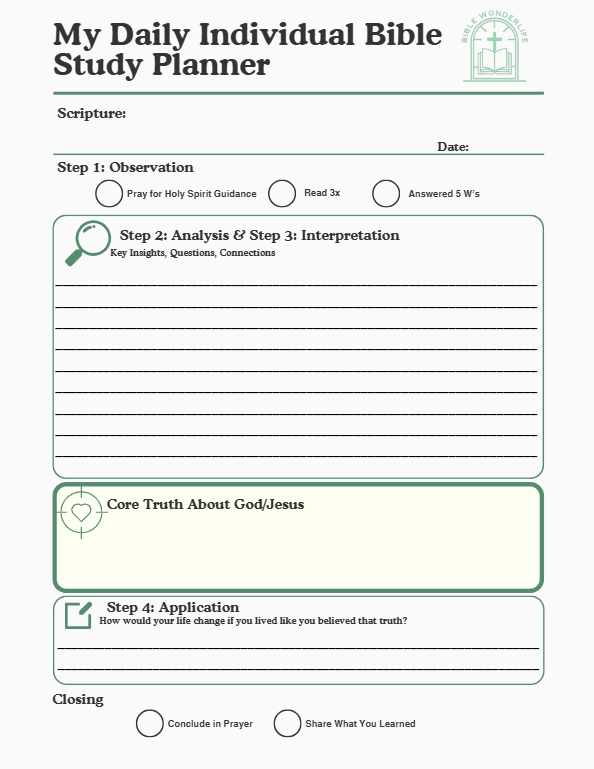
1. Get Your Application Checklist
Turn your study time into a focused routine. Download our free application planner (the Individual Study Worksheet) to help you keep track of your observations, interpretations, and—most importantly—your specific applications every single day.
2. Ready to Deepen Your Toolkit?
If you decide that your three essentials aren’t enough, we have created a comprehensive guide to all the reference tools available—dictionaries, concordances, and commentaries—so you can find the perfect supplement when you are ready.