
Learning how to study the Bible on your own can feel complicated. If you’ve ever felt overwhelmed by complex study methods or lengthy book lists, the SOAP Bible Study Method is the perfect solution.
SOAP is a simple, practical, and highly effective framework designed to help you not only understand Scripture but also apply its truths directly to your life. The method’s accessible structure ensures that anyone can benefit, regardless of their spiritual background or time constraints.
Answering a Few Common Questions about SOAP
Before we dive into the steps, here is a quick overview of what makes SOAP so beginner-friendly:
Overview of the SOAP Acronym
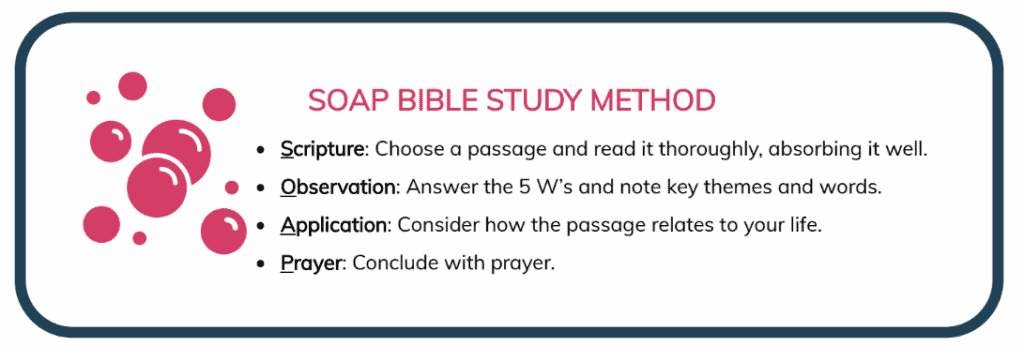
SOAP is an easy-to-remember acronym that guides you through the process of reading Scripture, analyzing it, and applying it to your life:
- S – Scripture: Choose a specific passage or verse to focus on.
- O – Observation: Make key notes about what the text says.
- A – Application: Determine what the text means for your specific life today.
- P – Prayer: Pray and respond to God based on what you have learned.
In this comprehensive guide, we will walk you through each letter in-depth, provide essential tips for success, and give you a powerful example to follow.
Why SOAP Works: Spiritual Benefits
The benefits of consistent Bible study extend far beyond simply gaining knowledge; they transform your character, emotional well-being, and relationships. Consistent use of the structured and accessible SOAP method can have a major impact on your spiritual growth and daily habits.
The Promise of Transformation
The Bible itself promises that time spent in God’s Word yields profound results:
“And I will give you a new heart, and a new spirit I will put within you. And I will remove the heart of stone from your flesh and give you a heart of flesh.” (Ezekiel 36:26)
Consistent engagement with Scripture is the key way God removes our “heart of stone” and guides us toward spiritual renewal.
The Proven Impact of Consistency
A recent study tracked 40,000 people ages 8 to 80 to measure the impact of consistent Scripture engagement on their daily lives. The study concluded that engaging with the Bible four or more days per week results in significant positive changes, making life healthier, happier, and more stable:
| Aspect of Well-Being | Impact from 4+ Days of Bible Study |
|---|---|
| Feeling Lonely | Drops 30% |
| Anger Issues | Drops 32% |
| Bitterness in Relationships | Drops 40% |
| Viewing Pornography | Drops 61% |
| Feeling Spiritually Stagnant | Drops 60% |
| Discipling Others | Jumps 230% |
The accessibility of the SOAP Bible study method makes achieving this consistency manageable. Overall, the method’s structured approach and focus on application will transform your Bible reading habit and, as a result, your entire life.
Before You Begin: The Toolkit & Mindset
The beautiful thing about the SOAP method is its low barrier to entry. You don’t need a huge budget or an overflowing bookshelf to start connecting with God’s Word.

The Minimalist Toolkit
SOAP requires very few physical items, allowing you to focus completely on the text.
- 1. A Bible: The source and ultimate authority.
- 2. Paper/Journal: Essential for recording your observations and applications.
- 3. Pen/Pencil: The tool for active engagement and analysis.
Need to simplify your study life? If you are feeling overwhelmed by all the possible resources out there (dictionaries, concordances, etc.), we highly recommend starting with our Minimalist Checklist of 3 Essentials for guidance.
Essential Tips for Beginners (The Mindset)
The mindset you bring to the table is just as important as your physical tools. Keep these tips in mind to ensure your SOAP study remains fruitful and flexible:
| Tip for Success | Rationale | Common Mistake to Avoid |
|---|---|---|
| Start Small | Begin with just one favorite verse or a short paragraph. You can learn a lot from a single verse! | Biting Off Too Much: Trying to do a full SOAP on an entire chapter is overwhelming and will lead to burnout. |
| Be Consistent, Not Perfect | Relationships with God take time. Aim for three or four days a week. Long-fought consistency is better than one-step perfection. | Treating it Like Homework: This is not a checklist to complete. Approach it with openness, not pressure. |
| Be Flexible | This guide is a framework, not a rulebook. If you are short on time, you can even do one part (S-O-A-P) each day. | Skipping Steps: If you are short on time, don’t skip Observation and jump straight to Application. You’ll miss the meaning! |
| Reflect Freely | There is no “wrong answer” in your journal. Write down whatever comes to mind—thoughts, feelings, fears, or a prayer. | Focusing on Yourself: While application is personal, ensure the main focus remains on God’s character and nature, which shapes your life. |
Step-by-Step Walkthrough: The “S” (Scripture)
The first step in the SOAP method is to choose and engage with the Word itself. This step is often the most overwhelming for beginners because the Bible is such a big book!
Choose a Passage to Study
When you are starting a new habit, it’s vital to choose something that interests you. This makes the habit stick.
- Follow Your Interest: Start with a favorite book (like Luke or John), a favorite character (like David), or even a favorite verse you already know.
- A General Rule of Thumb: Once you are reading within a book, a good way to determine your daily reading length is to follow the section headings in your Bible. These are the bolded titles added by editors to break the text into logical parts (e.g., “The Parable of the Sower”). Study from one heading to the next.
- Avoid the Mistake: Do not try to read an entire chapter in your SOAP study. Biting off too much will lead to exhaustion. SOAP is best for one or two verses, or a single paragraph.
Read it Multiple Times
Once you’ve chosen your section (e.g., Galatians 6:1-10), don’t just read it once. This is the observation foundation!
- Read the entire section 2–3 times. Get familiar with the context and the overall message.
- Read it in different translations. If you have a digital tool like the YouVersion Bible App, read the same verses in the NLT and the ESV. Seeing different wording can unlock valuable insights.
Choose a Specific Verse to Focus On (The Write-Down)
After reading the larger section for context, the SOAP method requires you to narrow your focus to 1–3 specific verses.
For example, after reading Galatians 6:1–10, let’s choose verse 9:
“Let us not become weary in doing good, for at the proper time we will reap a harvest if we do not give up.” (Galatians 6:9)
Crucial Action: Hand-write the verse you are focusing on at the top of your journal page. This keeps it in front of you at all times, and studies have shown that writing by hand aids comprehension and memorization.
Congratulations! You have completed the first step of your SOAP study. Now, let’s learn how to dive beneath the surface of the text.
Step-by-Step Walkthrough: The “O” (Observation)
The Observation step is where you become a detective. You are not yet trying to find the application for your life; you are simply trying to discover what the text actually says.
This is why skipping Observation is a major mistake. If you skip this step, you risk applying a meaning that was never actually there!
What to Look for in the Text
Your goal is to slow down and notice details. When studying your verse (e.g., Galatians 6:9), focus on the following key elements, writing down your findings in a bulleted list format:
| Observation Category | Description & Examples |
|---|---|
| Repetition | What words, phrases, or ideas are repeated? Authors use repetition for emphasis. (e.g., In Galatians 6:9: “Not becoming weary,” “not giving up”) |
| Compare/Contrast | Are two ideas or concepts being compared or contrasted? Look for relationships between similar or different ideas. (e.g., A gentle answer turns away wrath, but a harsh word stirs up anger.) |
| Cause & Effect | Look for words like “if…then,” “because,” or “for.” What action leads to what consequence? (e.g., In Galatians 6:9: If we don’t give up in doing good, then we’ll reap a harvest.) |
| Figures of Speech | Are there similes, metaphors, or imagery used to illustrate a point? Look for words like “like” or “as.” (e.g., In Galatians 6:9: “reap a harvest” is a metaphor for a reward, not literal farming.) |
| Lists | Are there any lists of virtues, vices, or items? Lists help us organize complex thoughts. (e.g., The fruit of the Spirit, the acts of the flesh, or a list of commands.) |
Contextual Observation
You also need to zoom out and observe the context of your passage:
- Author and Audience: Who is writing this (Paul)? Who are they writing to (Christians in Galatia)? Knowing this helps you understand the author’s intent.
- Stand-out Words: What words are interesting, unusual, or new to you? Write down those specific words for deeper analysis later.
Example Observation (Galatians 6:9)
Using our example verse, your observation notes might look like this:
“Let us not become weary in doing good, for at the proper time we will reap a harvest if we do not give up.”
- Repetition: “Not becoming weary” and “not giving up” are repeated ideas.
- Cause and Effect: The reward (“reap a harvest”) is conditional on perseverance (“if we do not give up”).
- Figures of Speech: “Reap a harvest” is a clear metaphor for seeing a reward for our efforts.
- Author/Audience: Paul is addressing “brothers and sisters” (Christians), implying this is a command for the believer.
Before you begin your observations, spend a moment in prayer asking God to help you see what He wants you to see. Trust the process!
Step-by-Step Walkthrough: The “A” (Application)
The Application step is the transformation point. This is where you move from gathering facts about the Bible (S and O) to allowing the Bible to change your life.
Before you apply the text, you must first discover the Meaning.
Meaning vs. Application
It is crucial to define these terms before you write anything down:
- Meaning: What the author is trying to communicate to the original audience. This is something you discover through your observations.
- Application: How you choose to respond to that meaning in your specific life today. This is something you create based on the meaning.
The meaning is stable; the application is personal and changes daily.
Discovering the Meaning
Review all your observations from the previous step. Then, ask two clarifying questions to boil the information down to its core message:
- What does this passage teach me about God (His character, nature, or will)?
- What does this passage teach me about humanity (our sin, potential, or need)?
Example Meaning (Galatians 6:9)
Looking back at our example:
“Let us not become weary in doing good, for at the proper time we will reap a harvest if we do not give up.”
- Meaning: The author (Paul) is reminding Christians that doing good is often exhausting, but God promises a future reward for those who persevere and do not quit doing what is right. The meaning is: A person will generally reap what they sow.

Finding Specific Application Points
Now that you have the meaning, you must translate it into a specific action.
Mistake to Avoid: Avoid vague applications like, “I need to be better.” Instead, your application must be Specific, Measurable, and Achievable (SMA).
To find your application, ask: Is there a command to obey, a promise to claim, or a sin to confess based on this meaning?
Example Application (Galatians 6:9)
- My Life: I have been tired of doing good by consistently praying for a friend who is struggling. I haven’t seen any change, and I want to quit praying.
- The Command/Promise: This verse commands me not to give up and promises a harvest.
- Specific Application: I will set a reminder on my phone to pray for my struggling friend every day this week at 7:00 AM, trusting that God’s harvest will come “at the proper time.”
Remember: Do not treat God like a genie when you pray or apply the text. Your focus is on aligning your life with His will, not twisting the text to fulfill your desires.
Step-by-Step Walkthrough: The “P” (Prayer)
The final step of the SOAP method is to Pray. This brings your focus back to God, ensuring that the study is completed as an act of worship and spiritual submission.
Prayer is where you confirm that you didn’t just study a book, but you had a genuine encounter with the Author.
The Act of Response
Your prayer should be a direct response to what you just learned, observed, and decided to apply.
- Reflection: Thank God for the specific truth He revealed. Use your observations and the meaning you discovered as the focus of your praise.
- Repentance/Confession: If the passage brought conviction about a sin, confess it and ask for forgiveness.
- Commitment: Lift up your specific application to God. Ask for the strength, discipline, and guidance of the Holy Spirit to live out that specific truth in the coming hours or days.
Example Prayer (Galatians 6:9)
A SOAP prayer is often short, honest, and direct:
“Father God, Paul is right. I get weary of doing good, especially when I don’t see any immediate fruit from my actions. Thank You for reminding me that I am sowing for Your glory and that the harvest is guaranteed to come at Your proper time. Strengthen me today to follow through on my commitment to pray for my friend every day this week at 7:00 AM. Keep my focus on Your faithfulness, not the immediate results. Amen.”
SOAP Prayer Template
While honest, extemporaneous prayer is always best, using a template can be helpful when you are new to the process or unsure how to start.
Here is a fill-in-the-blank template to help guide your thoughts at the end of your SOAP Bible Study:
| Template Section | Focus |
|---|---|
| Gratitude & Praise | Dear Heavenly Father, I thank You for speaking to me through Your Word, specifically [Scripture passage]. |
| Observation | As I reflect, I am encouraged by the truth that [mention one specific observation about God’s character/nature]. |
| Confession | Lord, I confess that I struggle with [confession or seeking forgiveness if applicable]. |
| Commitment | I ask for the strength and wisdom to follow through on my application to [specific application or action from Step A]. |
| Closing | May Your Word continue to transform me and draw me closer to You each day. In Jesus’ name, I pray. Amen. |
Your Turn: Let’s Practice
The best way to understand the SOAP method is to see it done. This interactive walkthrough uses a different passage, Psalm 23, and shows you exactly how to put all four steps together in a seamless, personal way.
SOAP is Your Sustainable Study Habit
You now possess a complete, easy-to-use framework for engaging with God’s Word daily. The SOAP Bible Study Method is effective because it forces you to move beyond passive reading and into active application and prayer.
The Core Goal: Consistency Over Complexity
Remember the vital lesson discussed earlier–transformation comes from consistency, not complex knowledge. SOAP is designed to be the sustainable study habit that keeps you engaged four or more days a week.
| SOAP Letter | Action | Why it Matters |
|---|---|---|
| S | Focuses the Eye | Ensures you are studying the Bible, not just opinions. |
| O | Engages the Mind | Forces you to see what God said, not what you think He said. |
| A | Challenges the Will | Translates ancient truth into a specific, modern action. |
| P | Centers the Heart | Submits the entire process back to God as an act of worship. |
Next Steps
The time to start is now. Don’t wait until you have a perfect hour or a perfect journal. Grab your Bible and a piece of scrap paper, and try the SOAP method on the very next verse you read.
- Download Your Complete Habit Guide (Includes Worksheet!):To help you make SOAP a daily habit, we’ve created a comprehensive resource. Our Building a Bible Study Habit Guide includes scheduling tips, motivation strategies, and your free, printable SOAP Study Worksheet with dedicated space for all four steps. Download your FREE Building A Bible Study Habit Guide Now!
- Continue Your Study Journey:
- Is SOAP Right for You? If you’re wondering how SOAP compares to general reading, check out: SOAP vs. Devotional: Vital & Important Differences
- Need Alternatives? If you love the framework but want to try something new, explore: Like or Dislike SOAP? Try These Alternatives
- Family Study: Get your children involved with the method you’ve learned: SOAP Bible Study For Kids with Kid Friendly Bible Tools
- Explore Other Deep Study Methods:Once you’ve mastered SOAP and are ready to expand your study toolkit, consider exploring these complementary methods:
- Lectio Divina: A slower, more meditative method focused on hearing God’s voice (Perfect for after a SOAP study).
- Inductive Study: A highly detailed method perfect for deep-diving into entire books of the Bible.
Building a Bible Study Routine Guide
Want to build a Bible study habit? Sign up for our monthly newsletter and we will send you our free Building a Bible Study Routine Guide. You’ll discover your ideal Bible study method and create a customized schedule. Plus, much more.
Here is what you can expect as a Bible Wonderlife subscriber:
-Welcome email with your Free Guide right now!
-Monthly emails with a brief devotional.
-Practical tips and helpful information for growing in your faith.

Building a Bible Study Routine Guide
Want to build a Bible study habit? Sign up for our monthly newsletter and we will send you our free Building a Bible Study Routine Guide. You’ll discover your ideal Bible study method and create a customized schedule. Plus, much more.
Here is what you can expect as a Bible Wonderlife subscriber:
-Welcome email with your Free Guide right now!
-Monthly emails with a brief devotional.
-Practical tips and helpful information for growing in your faith.