
Are you tired of reading the Bible and feeling like you don’t actually understand what it means? Do you ever worry that you are only repeating what others say, or accidentally reading your own ideas into the sacred text?
The solution is the Inductive Bible Study Method: a reliable, step-by-step approach that teaches you to draw the truth out of the Bible by observing the text for yourself, ensuring you know what it truly says.
This guide will give you the precise, 3-step blueprint to unlock Scripture’s original meaning and confidently apply its life-changing truths to your everyday life.
What is Inductive Bible Study?
The Inductive Bible Study method is an essential skill for anyone who desires to understand Scripture on its own terms. It moves from specific details in the text (Observation) to broad conclusions about the text (Interpretation and Application). This rigorous yet simple method is perfect for curiosity-driven people who love to learn!
Through careful observation, critical questioning, and drawing conclusions, Inductive Bible study empowers you to discover the original meaning for yourself.
The entire process is anchored by three logical steps, designed to ensure you get the most out of your reading:
| Step | Core Question | Focus |
|---|---|---|
| Observation | What does the text say? | Identifying the facts, structure, and repeated themes. |
| Interpretation | What does the text mean? | Discovering the original meaning in its context (to the original audience). |
| Application | How does the text change me? | Personalizing the universal truth and committing to practical change. |
Why Inductive Bible Study is Transformational
Inductive Bible study is the gold standard for personal study because it ensures you are not reading your own assumptions into the text (deductive reading), but rather drawing the meaning out of the text.
This approach results in numerous benefits, leading most importantly to a life-transforming encounter with God through a personal experience with the Bible.
Studies and experience show that inductive Bible study can:
- Anchor Your Faith: Deepen your understanding and appreciation for God’s Word.
- Keep It Relevant: Ensure the ancient text remains vital and applicable to your modern life.
- Build Wisdom: Create the ability to make wise, biblically-based choices.
- Promote Growth: Ultimately, transform you to live more like Christ.
If you are interested in knowing more about the profound and long-lasting effects of this practice, be sure to check out this article. You’ll explore nine amazing life-changing benefits of the inductive Bible study method while you discover its purpose.
Is Inductive Bible Study Biblical?
Yes, absolutely. A biblical Bible study method must meet certain criteria that ensure we handle the Scripture with respect and humility. Inductive study aligns perfectly with the goal of biblical literacy because it:
- Values Scripture as God’s authoritative, inspired Word.
- Deepens our understanding and appreciation for the text.
- Leads to a better picture of Jesus (the central theme of all Scripture).
- Involves constant interaction with God’s Word (not just reading commentaries).
- Changes us, resulting in personal growth and sanctification.
Because the Inductive Method forces this constant, direct interaction with the text, it naturally fulfills these biblical requirements.
Preparing for Your Study
Now that we know for certain that Inductive Bible Study is biblical and highly effective, we can dive into preparing for our first study. The time you spend preparing is critical, as it removes distractions and sets your heart in the right posture to hear from God.
To do that, we’ll focus on three key actions: Prayerful Beginning, Choosing a Translation, and Gathering Essential Tools.
A Prayerful Beginning
The whole purpose of Bible study is to encounter God through His Word. This time is not simply an academic exercise; it is an act of worship. Therefore, we should spend some time in prayer before we start studying.
- Posture of Humility: Praying for God to speak to us through His word creates a posture of humility and teachability.
- Heart Alignment: It allows us to get our heart in the right place to hear from God and gives us the opportunity to speak directly to the Author of the Bible.
Example Prayer: “Dear God, I come before You as I begin this journey of Bible study. Open my eyes and soften my heart that I may see You in ways I never have before. Help me to grow in faith and love towards You. May this time be a special time where I encounter You. Amen.”
Curious what exactly to pray? Then be sure to check out this article that provides the top five things to pray before Bible study.
Choosing Your Translation
When doing an inductive Bible study, it is helpful to read the passage in multiple translations. When we compare different translations, we gain a big-picture understanding of the meaning and tone of the original language.
Bible translations typically fall on a continuum based on their approach:
| Approach | Focus | Description | Examples |
|---|---|---|---|
| Word-for-Word | Formal Equivalence | Focuses on translating each Hebrew/Greek word as literally as possible. Best for detailed observation and interpretation. | NASB, KJV, ESV |
| Thought-for-Thought | Functional/Dynamic Equivalence | Focuses on translating the idea or phrase to make the meaning clearer in modern language. Best for quick comprehension. | NIV, NIRV, NLT |
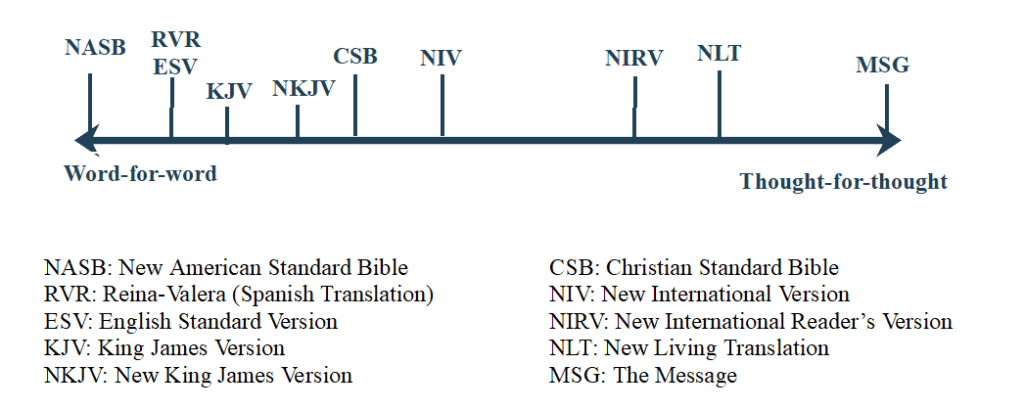
The best approach for Inductive Study is often to start with a middle-of-the-road translation (like the NIV) and compare it with a word-for-word translation (like the ESV or NASB). This balances readability with accuracy.
To help you choose the best translation for you, be sure to check out this article that explains why we have so many different translations and provides tips for choosing one.
Gathering Essential Tools
The Inductive Bible Study method emphasizes making detailed observations of the text. To make this a little easier, some Bible study tools will be helpful, though you don’t need many to start!
Essential Tools (Bare Minimum)
Honestly, there are only two tools that are truly essential for Inductive Bible study:
- A good Study Bible: The notes and introductions can provide initial context, but remember to save the in-depth reading of the notes for after you have done your own observation.
- A notebook and pen: These two tools alone are necessary for recording your observations, marking the text, and working through the steps.
Recommended Tools (For Deeper Study)
As you advance, these tools can make exploring the historical, cultural, and linguistic contexts easier:
- A Bible handbook (for background)
- A Bible Dictionary or Encyclopedia
- A Concordance (for word look-up)
- Commentaries (to be used after Step 2)
- A Theological Dictionary
For a complete list of Bible study tools that I recommend, check out the Wonderlife Toolkit. It offers a curated, personally tested list of resources guaranteed to deepen your encounter with God’s Word.
Choosing Your First Passage of Scripture
When choosing a section of Scripture, start with a favorite book or passage that you are interested in. Starting there will encourage you to keep wanting to learn how to study the Bible and make this a more interesting adventure.
Step 1: Observation (What Does It Say?)
The first and most critical step in Inductive Bible Study is Observation. You must become a spiritual detective, making detailed observations of the passage before you ask what it means or how it applies. This step prevents you from making assumptions.
The core question we are answering here is: “What does the text say?”
What to Look For (Key Observation Categories)
To ensure your observation is thorough, look for these specific elements in the text. Read the passage three to five times, focusing on one category at a time.
| Category | Description | Example Focus |
|---|---|---|
| Repeats & Themes | Words, phrases, or ideas that are mentioned more than once. | Look for God’s name, the theme of judgment, or repeated actions. |
| Structure & Flow | Transition words, cause/effect, and lists that reveal the passage’s logic. | Look for words like: Therefore, So that, If… Then, Because. |
| Comparisons & Contrasts | How people, concepts, or actions are shown to be alike or different. | Look for phrases like: Just as… So also, Not this… But that, Like. |
| Key Literary Elements | The presence of figures of speech, dialogue, or strong verbs. | Mark the Verbs (actions), Pronouns (who is talking/acting), and Questions asked. |
Ways to Make Observations
The key to observation is to record what you see. You can get creative with how you mark your observations, letting your personal learning style shine. Experiment with different methods until you find what helps you see the connections and relationships between the phrases and thoughts.
1. Highlighting and Taking Notes
Many people choose to use different color highlighters to mark different elements. For example:
- Names of God or Deity: Light Blue
- Commands or Calls to Action: Green
- Promises of God: Yellow
- Contrasts/Warnings: Red
2. Using Inductive Bible Study Symbols
Some people use specific symbols to mark key words of a passage they are reading. This visual shorthand is highly effective for quickly seeing themes across a book or chapter.
- A little triangle near every mention of God.
- A person icon over pronouns referring to people.
- A arrow connecting cause and effect phrases.
This article will go into more depth about the common inductive Bible study symbols and how to create your own.
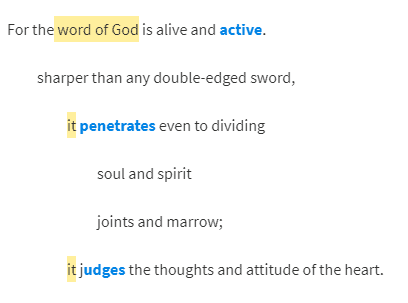
3. Using a Block Diagram (Structural Overview)
A block diagram is a visual representation of a biblical passage that simplifies the organization and structure of the passage you are studying. It is excellent for showing how subordinate ideas support a main idea.
By breaking down the text into these visual components, a block diagram provides a clear and concise overview, helping you to analyze and grasp the passage’s flow, key themes, and main ideas.
Step 2: Interpretation (What Does It Mean?)
Now that you have a comprehensive list of observations about the text, the next step is Interpretation. This is where you determine what the passage meant to the original audience.
The core question we are answering here is: “What does the text mean?”
Interpretation requires moving outside the text to understand its context. What a Bible passage means today should be the same as what it meant to the original readers. We do this by examining the Historical/Cultural Context and the Literary Context.
Understanding the Historical and Cultural Context
To accurately interpret a passage, we must step back in time. We need to answer the questions: Who wrote this? and Who was the audience? This is where tools like Bible handbooks and dictionaries become invaluable.
| Content Area | Questions to Ask |
|---|---|
| Author | Who wrote this? What was his ministry? When did he write? |
| Audience | Who are the recipients? What is their relationship with God? What is their current circumstance? |
| Purpose | Why was the book/letter written? |
Understanding the Literary Context
The Bible is a library of different literary forms, or genres. The way you interpret a proverb is different from the way you interpret a prophecy. Looking at the literary genre prevents you from taking figurative language (like “the mountains… will burst into song”) literally.
Literary Genres in the Bible
| Literary Genre | Characteristics | Interpretation Considerations |
|---|---|---|
| Narrative | Storytelling, characters, plot | Focus on understanding characters, events, and moral lessons. |
| Poetry | Poetic language, metaphors | Appreciate the artistic and emotional elements; look for deeper meanings in metaphors and imagery. |
| Prophecy | Predictions, visions, symbols | Consider historical context, fulfillments, and symbolic language. |
| Epistle (Letter) | Formal letters, instructions | Pay attention to the recipients, cultural context, and practical advice. |
| Wisdom Literature | Proverbs, wisdom sayings | Extract timeless principles and practical wisdom for life. |
| Apocalyptic | Symbolism, visions, future | Interpret symbols and visions, often focusing on eschatological themes. |
| Parable | Allegorical stories | Seek the underlying spiritual or moral lessons conveyed. |
| Historical Account | Detailed historical records | Understand historical context, events, and cultural backgrounds. |
| Law | Legal commands, regulations | Recognize the specific laws and their application in ancient Israel. |
Look Up Key Words
Another essential part of interpretation is defining key words that stand out from your observation stage. Do not assume you know the full meaning of a word; use a concordance or an expository dictionary to explore the original Hebrew or Greek.
Identifying the Big Picture Principle (The Meaning)
This final step of Interpretation synthesizes everything you have learned to find the single, timeless truth of the passage. The meaning you land on should be:
- Reflected in the verse or text: Directly supported by your observations.
- Universal: For everyone, everywhere, at every time.
- Biblical: Consistent with what the rest of the Bible says.
- Relevant: Applies to both the original audience and people today.
To identify this principle, ask these guiding questions:
- What does this say about who God is (His nature, character, or action)?
- What does this say about who we are (our condition, need, or potential)?
- What does this say about God’s desire for people?
Now that we have the timeless, universal meaning, we are ready to move to the final step: making it personal.
Step 3: Application (How Does It Change Me?)
The final stage of the Inductive Method is the most personal: Application. You move from the universal truth you discovered in Step 2 to the specific changes required in your own life today.
The core question we are answering here is: “How does the text change me?”
We don’t study the Bible just to gain knowledge; we study it to be transformed by God. This step takes the universal meaning and brings it crashing into your everyday reality.
Personalize the Meaning to Daily Life
To apply the meaning, we look for parallels between the text’s situation and our own lives. We ask: “If this truth was true for the original audience, how is it true for me right now?”
To make this practical, look for specific elements in the text and see how they manifest in your life.
Make a Plan for Change
Application is not complete until it results in an actionable step. You must translate the biblical principle into a real-world commitment.
When looking for an application, consider whether or not there is a:
- Sin to confess (and stop doing).
- Attitude to change (e.g., replace worry with trust).
- Promise to claim (and rest in).
- Command to obey (a specific action).
- Truth to believe (and meditate on).
- Something to praise God for (a reason for worship).
Overcoming Beginner Challenges & Key Tips
Learning a new skill, especially one as profound as Inductive Bible Study, comes with its challenges. By being aware of these common pitfalls and applying simple tips, you can ensure your study remains fruitful and Christ-centered.
Avoiding Challenges in Interpretation
The main dangers in Bible study occur during the Interpretation step when we are tempted to make the text say what we want it to say, rather than what it actually says.
| Danger | Description | Solution |
|---|---|---|
| Twisting the Text | Trying to force the text to fit a personal belief or modern context without respecting the original meaning. | Prioritize Context: Always ask, “What did this mean to the first readers?” |
| Missing the Forest | Getting lost in small details (word studies, symbols) and failing to see the main theme or Big Picture Principle. | Review Observation: Step back and look for the main idea that ties all your observations together. |
| Pride | Thinking we know what the Bible says without needing the Holy Spirit, leading to an unteachable heart. | Stay Humble: Remember to pray consistently, asking the Holy Spirit for guidance and wisdom. |
| Rushing | Trying to complete all three steps (Observation, Interpretation, Application) in a single, short sitting. | Take Your Time: Spread the three steps out over a few days or even a week. Quality of study is more important than speed. |
Don’t let these dangers scare you. The Holy Spirit is the ultimate guide and will help you determine the meaning and steer you past these pitfalls safely.
Key Tips for Successful Study
Successful inductive Bible study is entirely possible. You can master this method when you set achievable goals, establish a study routine, and maintain a humble attitude.
Set Achievable Goals
Learning to study the Bible is a process of learning and developing new skills. This chart is designed to help you focus on mastering one skill at a time, so you don’t feel overwhelmed trying to learn everything at once.
| Goal | Description | How to Achieve It | Timeframe |
|---|---|---|---|
| Observation Skills | Improve observation of key words and structures. | Practice marking and noting details in the text for 2-3 weeks before moving on. | 2-3 Weeks |
| Contextual Understanding | Understand historical, cultural, and literary context. | Research the background of the passage and practice looking up key words. | 2 Weeks |
| Interpretation | Learn to interpret the text correctly. | Practice identifying the Big Picture Principle of the passage. | 2 Weeks |
| Application | Apply Biblical principles to daily life consistently. | Identify and practice applying lessons (Sin to confess, Promise to claim, etc.). | Ongoing |
Consider Joining A Bible Study Group
Joining a Bible study group is a great way to maintain accountability and enhance your understanding. By surrounding yourself with others who desire to study the Bible, you gain encouragement and a diversity of observations.
- Group Study Benefit: Group members can often point out observations you missed, enriching your Step 1 (Observation) process.
If you are a new believer and unsure about joining a group, then consider reading this article that will tell you exactly what to expect in a Bible study group.
Your Turn: Let’s Practice
Building a Bible Study Routine Guide
Want to build a Bible study habit? Sign up for our monthly newsletter and we will send you our free Building a Bible Study Routine Guide. You’ll discover your ideal Bible study method and create a customized schedule. Plus, much more.
Here is what you can expect as a Bible Wonderlife subscriber:
-Welcome email with your Free Guide right now!
-Monthly emails with a brief devotional.
-Practical tips and helpful information for growing in your faith.

Building a Bible Study Routine Guide
Want to build a Bible study habit? Sign up for our monthly newsletter and we will send you our free Building a Bible Study Routine Guide. You’ll discover your ideal Bible study method and create a customized schedule. Plus, much more.
Here is what you can expect as a Bible Wonderlife subscriber:
-Welcome email with your Free Guide right now!
-Monthly emails with a brief devotional.
-Practical tips and helpful information for growing in your faith.
Final Conclusion: The Blueprint for Discovery
Congratulations! You have successfully mastered the three essential steps of the Inductive Bible Study Method. You now possess the blueprint for moving beyond simply reading the Bible to truly understanding and applying its timeless truths.
The Inductive Method: Your Blueprint
Always remember the three non-negotiable questions that guide your study:
| Step | Key Question | Goal |
|---|---|---|
| Observation | What does the text say? | Note the facts, look for key repeats and contrasts, and mark the structure. |
| Interpretation | What did the text mean? | Determine the historical and literary context to find the single Big Picture Principle (the universal meaning). |
| Application | How does the text change me now? | Personalize the universal truth into a specific, actionable commitment for this week. |
The Value of Consistency
This method is powerful, but its true benefit comes through consistency. The goal is not just to finish one study but to build a lasting habit of encountering God through His Word. Start small, be patient with yourself, and remember that the Holy Spirit is your ultimate guide and teacher.
Claim Your Free Study Routine Guide
To help you seamlessly integrate this Inductive approach into your daily life and maintain the consistency you need, we have created a resource just for you.
Download Your FREE Bible Study Routine Guide!
This comprehensive guide includes scheduling tips, motivation strategies, and a printable Inductive Bible Study worksheet to help you formalize your quiet time.
Building a Bible Study Routine Guide
Want to build a Bible study habit? Sign up for our monthly newsletter and we will send you our free Building a Bible Study Routine Guide. You’ll discover your ideal Bible study method and create a customized schedule. Plus, much more.
Here is what you can expect as a Bible Wonderlife subscriber:
-Welcome email with your Free Guide right now!
-Monthly emails with a brief devotional.
-Practical tips and helpful information for growing in your faith.
